

Developmental Update
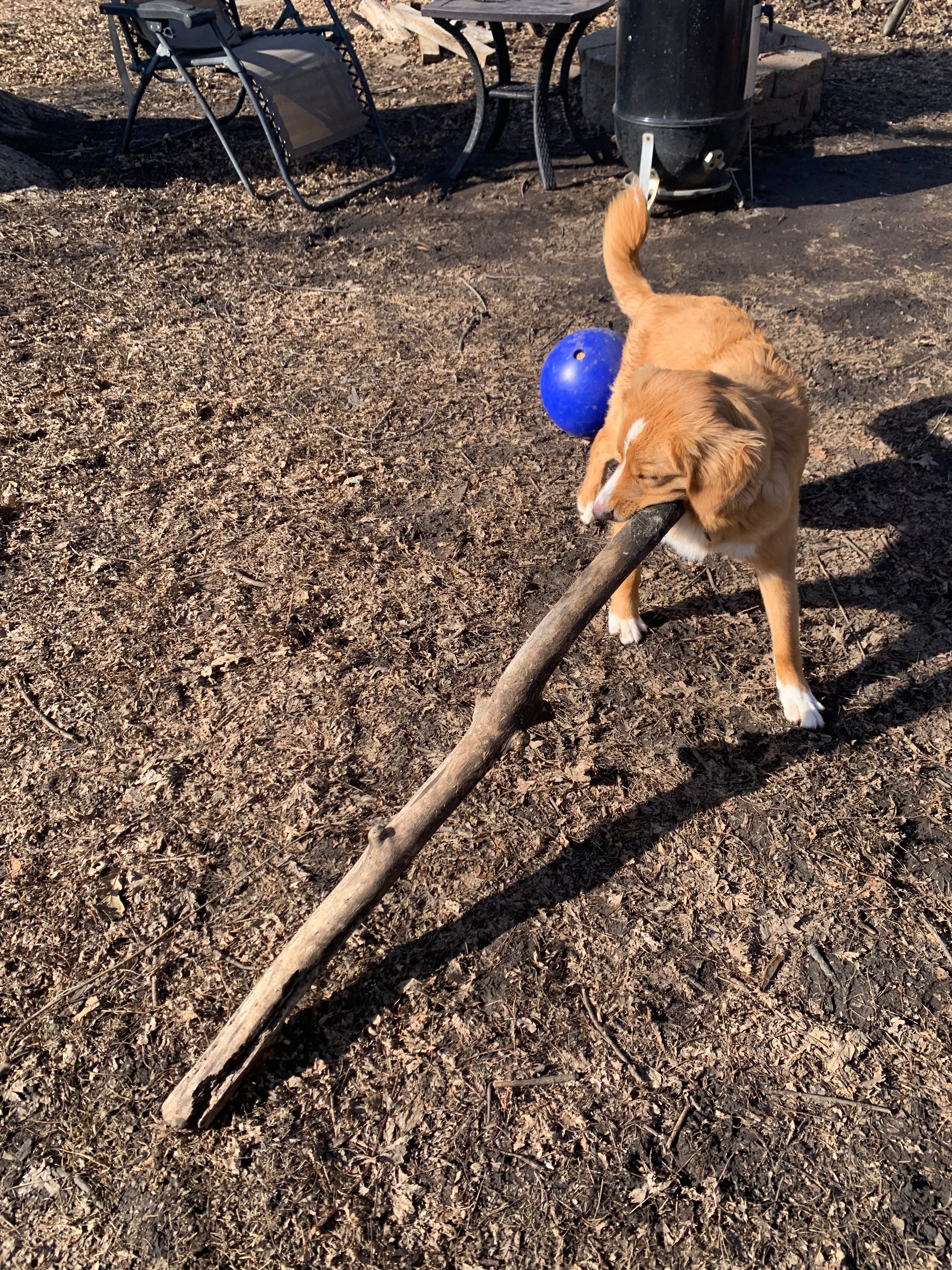
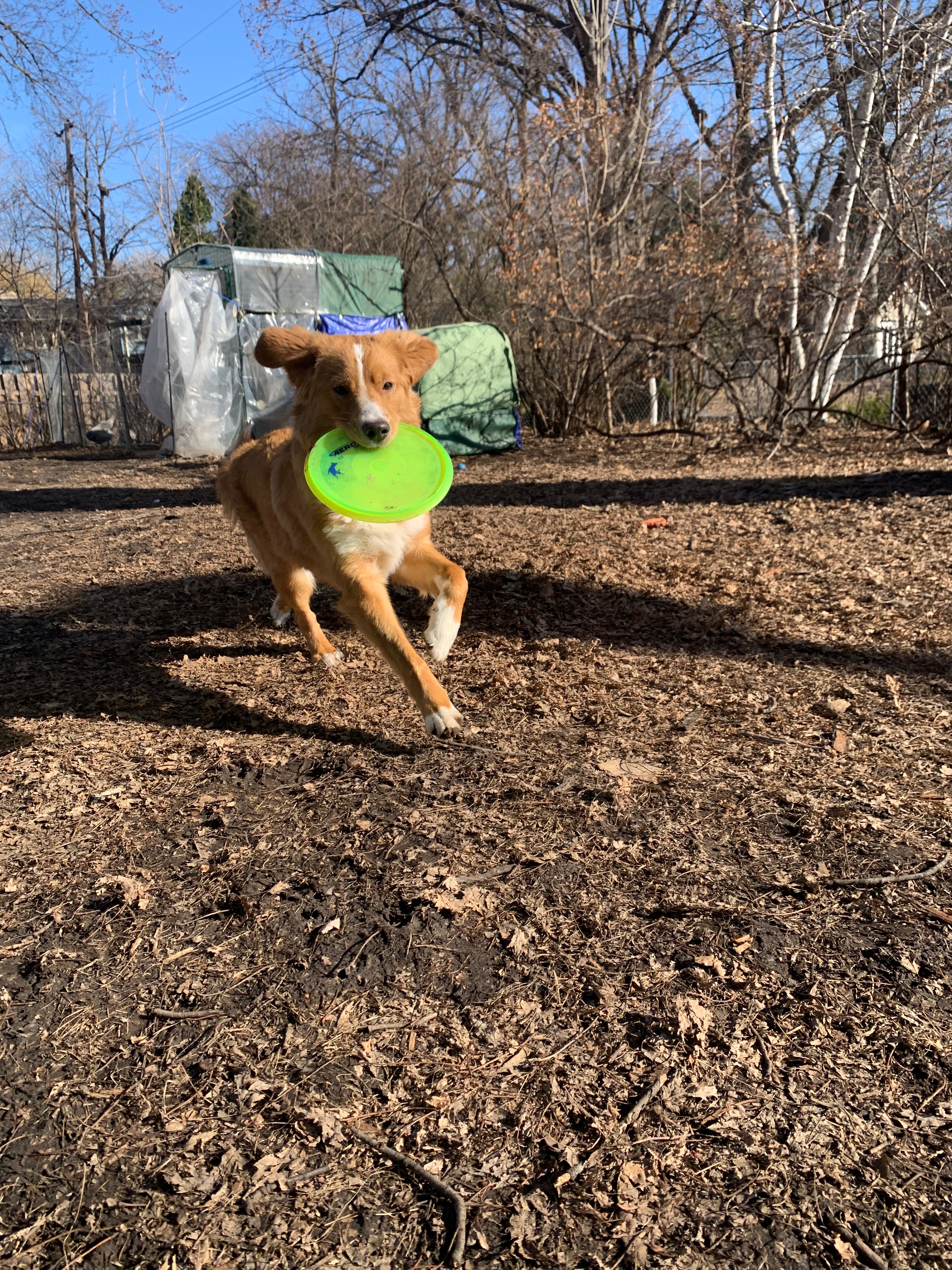
Waffles is now 7 months old, still full of beans, and growing into a lovely adolescent boy. Canine teens certainly enjoy a life of CRIME. Waffles is a shameless recidivist. And I love every minute of it, even when the CRIMES drive me completely insane!
On the training front, things are going well: we’re working easy public access skills, doing a lot of neutral socialization work, and learning to tell the difference between “on the job” and “off the job” behaviors.
He has his neighborhood fan club and an endless supply of volunteers helping us to train polite greetings as well as the fine art of being bored and ignored by people because we’re working. There are a couple of neighborhood kids who’ve been knocking on our door to ask if Waffles can come out to play and train, and they’ve been a great help in teaching him a release-to-greet command, as well as exposing him to tons of things like scooters, bikes, and distractions.

Waffles enjoys learning new tricks — building blocks of future skills — such as how to press buttons to open doors or turn on the crosswalk signals. He has learned the early pieces needed for guiding work, such as the commands Follow, Lead-On, Turn Right, Turn Left, Around, Walk-On, Steady, and Halt.

Now that the weather’s nice, he’s been enjoying a ton of long-line walks in the woods, exploring ponds and checking out ducks, and puttering about in the water and mud!

Waffles also has no sense of personal space and thinks snuggles are the best thing ever. Here he is “mauling” one of our visitors half to death.

He’s a very snuggly boy who loves a good cuddle. I know tollers are often thought of as aloof and not huge snugglers, but I’ve found that many are — it really does depend on their parents, grandparents, and the type of temperaments their breeders strive for when it comes to social drive, willingness to please, and levels of anxiety. One of Waffles’ most adorable quirks is his love of holding your hand when he’s getting petted, and needing to do full-body leans when returning with fetching toys if you’re sitting on the floor with him. He’s also a big fan of headbutts. Also? Crime.

Training Update
Adolescence. It’s a THING.

Just because I have a decent amount of experience training working dogs doesn’t mean I don’t have the same type of Adolescent Dog Training Struggles ™ EVERYBODY has. Social media would have you believe that trainers are magicians and that their dogs are “a little naughty” but under perfect control. I want you all to be well aware that I’m no magician. My puppy is an insufferable recidivist full of CRIMES right now. Do I have a lot of experience? Sure! Do I do it all alone? Nope! I rely on fellow trainers to help me spot issues with my handling, training hiccups, troubleshooting behaviors, and creative ways to teach new skills. We are still doing some group classes (mostly for distraction exposure) and are also working one on one with a trainer so we can iron out specific behaviors I want to shape. She’s an amazing resource, and great to commiserate with. There’s nothing like having another brain to help you come up with new ideas or implement old ones you’d totally forgotten existed!

Waffles is at the prime age for Crimes. It’s what he thinks about, most of the time: how to get into trouble, push boundaries, do stuff he shouldn’t do, get into things he shouldn’t get into, and generally act like a menace. Tis the age. And it’s often ridiculously funny. Do I encourage crimes? If it’s safe and something he’ll learn from? Absolutely. Go explore. Blow me off. Check out the wobbly things. Get muddy. Attack the water coming out of the hose. Steal a thing so I’ll trade you for something better. Push those boundaries. Learn something. FAFO once in a while. Enjoy the consequences of your poor choices. It’s how you learn. Failure and consequence are important components of learning. Do I set up my dog to fail? No! Not when I’m teaching him something new. I set him up to succeed. Do I let him try stuff out and fail, under controlled circumstances? Absolutely. He’s a smart boy who needs to learn how to be frustrated, stick with a problem, and sometimes not get what he wants (and having to live with that fact.) The advantage of this approach? You get a thinking dog who isn’t afraid of things and who can solve problems. The disadvantage of this approach? You get a thinking dog who isn’t afraid of things and who can solve problems. Pick your poison. Or your CRIMES.

Staying positive during the Age of Crimes can be so very hard for pet parents and trainers alike. Your perfect puppy is now a full-fledged adolescent who blows you off at the drop of a hat. It can be frustrating! It can be disheartening! And while some will refuse to admit it, it happens to working dog candidates, too. It happens to the trainer’s dogs. It happens to the breeder’s dog, to the professional handler’s dog, to the K9 handler’s dog… adolescence comes for us all and is a humbling time even for the most seasoned trainers. Here are the things we’re struggling with at 7 months:
- High distractibility: Everything is fascinating, everything moves, everything makes noise, everything deserves investigation. It’s a pain in the rear when you’re trying to go for a nice, calm walk or a training session. Gosh darn it.
- Random fears: They’re transient and never last, but sometimes random things will startle a teenage dog. Sometimes, you start wondering if they’ll ever bounce back! They used to be so brave, and now they’re being spooky! It’s normal. This is the age of exploration and flight, where their wild cousins learn about the dangers of the world around them. Support them through it. More on that in a sec.
- Barking: We’ve discovered our big boy voice and we’re not afraid to use it. Now is the time to teach “Speak” and “Quiet” so we can keep that barking down to a minimum. We’ve also discovered our Toller Scream. Pray for us.
- Mouthiness: Some puppies outgrow mouthiness around 6 months. Retrievers and herding breeds sometimes remain a little chompy for a while longer, especially if they’re being trained to pick up and carry things. Some just enjoy exploring the world mouth first, so while you watch your obedience classmates enjoy chomp-free time and you feel like despairing, don’t. It’s normal, but it does need to be addressed. Waffles is a notorious chomper — has always been — so we’re just keeping on walking away and removing ourselves when he’s overstimulated or overtired and gets mouthy. Remember that naps are your best friend. Waffles is like clockwork. When he’s tired, he gets chompy and humpy.
- SPEAKING OF… oh, the humping: HORMONES, BABY! WOOOOO! Waffles has discovered the joys of “the evening humpies” — no use getting mad or upset about it, it’s a normal thing, he’s an adolescent. I usually tell him that’s something gentlemen don’t do in public and step away from him. He’s learning that when the behavior starts up, he gets ditched. Natural consequences, baby! Works for toddlers AND teenagers, whether human or canine!
- Naughtiness in class: We’ve all been there. Some of us (including me) more than others. There are weeks where you show up to class knowing that you’re going to have the classroom clown and/or delinquent. This is us right now. And that’s okay. Consider it a public service: everyone else can walk away feeling better about their dog’s behavior while you provide them with a good laugh. Honestly though — your positive attitude about your teen’s antics goes straight down the leash, especially in clever breeds. They know they’re being turds, and they’ll feed off your reactions. Waffles is a puppy who gets easily bored. Group class goes way too slow for him and has way too much talky-talky by instructors. And that’s okay! I’m not fussed, so he’s not fussed, and we have a good time, despite the crimes. (To be totally honest, I’d rather have the dog who is creatively disobedient, who gets into trouble because he’s a great problem solver, and who keeps me on my toes.)
- Recall? What recall? All teenagers enjoy blowing off a good recall. Waffles is no exception. Now’s a good time to bring back jackpot treating for ALL off-leash recalls. Arm yourself with patience and praise them for making good choices.
- Motion Sickness: This isn’t a behavioral thing as much as an inner-ear developmental thing, and he’s always been this way. Poor Waffles is still motion sick, but he now has meds to help him combat the yarfs. He’s become a little anxious about car rides — we know it’s not the anxiety causing the sickness, it’s the other way around. I don’t blame him, I’m the same way! The vet agrees that he’ll outgrow it as he gets older and his inner-ear finishes developing, but for now we’re treating with meclizine for short trips and Cerenia for longer ones. He’s doing great!

One thing that helps me survive teenagehood with a “Thinking Breed” like the NSDTRs is working in a more conversational way with my dogs. Yep, we talk a lot. It’s not for everyone — and not for every breed. Some dogs can’t handle training in a conversational way because commands get lost in the “noise” of conversation. Or they simply don’t have the cognitive space to hold many words or phrases in their vocabulary. When it comes to NSDTRs, Border Collies, Kelpies, Cattle Dogs, Shepherds (Dutch, Belgian, Australian, German, and so on) a conversational approach is sometimes incredibly effective. I find working Goldens, Labradors, German Shepherds, and Poodles to be excellent volunteer workers. They learn the behavior-reinforcer(treat)-repeat triangle quickly and enjoy working for the sake of pleasing their handler. They usually learn to work around distractions pretty easily, they’re not as likely to focus on all-the-things-that-move when they’re out and about training. The Thinking Breeds? Not so much. Everything is interesting. Everything needs to be noticed. They prefer a partnership and, when it comes to working, they’re more likely to form a union with a collective bargaining unit to demand fair wages for their troubles. Given the reasons and jobs they were specifically bred for, this makes sense. What does that mean in practice, though?

I talk to my dogs. I name things. I acknowledge what they see and hear at this age, and reinforce calm responses. Their vocabulary capacity is huge, as is their ability to lump things into categories. So during a walk, if my adolescent dog gets distracted by dogs barking in a yard or in a house, I’ll tell him: “Those are Neighbor Dogs. They’re barking. No need to fuss. Walk on.” He spots a weird plastic bag flapping in the wind against a fence and stops, curious and thinking about barking about it? “It’s a bag, Waffles. No big deal.” A squirrel darts across the street while we’re training! “That’s Frank. He lives here. It’s fine.” We’re at the library and the door opens behind him, startling him. “It’s the door, Waffles. I see it.” We’re at training and the dogs in the kennels are barking. “Yep, I hear Friends barking. Just ignore it.”

It’s funny how by just acknowledging that I heard or saw what he’s heard or seen goes a long way into him deciding whether or not he needs to do something about it. Half of it is tone — he responds to the calmness of my NPR voice. Half of it is him filing away the noun that goes with it. The more he hears it, the more “Neighbor Dog” and “Friend” and “Loud Truck” and “Bag” and “Flag” and “Traffic Cone” enters his vocabulary. When we encounter something like it later and I name it, it gets filed into the same category and in the “no need to fuss” box. I learned this week that some trainers call this the “Mr. Rogers’ Neighborhood” Hack — name things, calmly, to demystify them, just like you would do for a toddler or a preschooler. Does this work for all dogs? No. Some just get worked up and essentially just hear the Peanuts Adults making noise at them when we speak. Waffles, however, is used to parsing words. I can bury a command in a long string of nonsense words and he’ll pick it up. This has allowed his vocabulary for commonly encountered things to grow. So now when we encounter something that makes him think about stopping in his tracks he turns his head and looks up at me for acknowledgement. “Yep, buddy, I see it. It’s fine!” … and he just carries on. This is how I build bomb-proof working dogs. As he grows, he’ll learn to interpret what he sees, decide if it’s just one of those normal occurrences or something he should warn me about: for example, if I ask him to cross a street in low light and he realizes that a bike is coming at us really fast but I can’t see it — I want him to go “yeah, nah, you don’t see that, do you…” and refuse to cross. Right now he’s being taught what he should ignore so that he can learn what needs to be noticed and acted upon later.

Does this require more time and work than most training programs can put in? Absolutely. Does it work for all dogs? Absolutely not. Is it worth it if it works for your dog? Definitely. Does it keep me sane through this difficult Age of Crimes? Oh heavens, yes.

Have a great week, everyone! Keep training, keep playing, and even if your teenager drives you bananas, remember to have fun. It will pass. On the other side of it all, you’ll have a wonderful companion for all life’s adventures. Our goal as pet parents (well, as parents in general, really!) is to raise good citizens who are fun to be around. It takes time and patience. Hang in there. 🙂
 Keep Calm & Waffle On
Leave a comment