

The Breakfast of Champions had another fantastic training week! He’s doing very well in school and during our public training outings. Despite being an absolute shark at the moment (teeth, so many teeth!) he’s making progress by leaps and bounds. This week’s class focus (beyond focus and distractions!) has been on heeling with automatic sits without luring, down-stay on his mat without luring, and the Emergency Recall. The first two are pretty self-explanatory — I push a little more than the basics and also do heeling on the opposite side and “middle”, and practice transitioning from one position to the other between automatic sits. He loves it, especially when we move fast fast fast! Slow is for chumps.
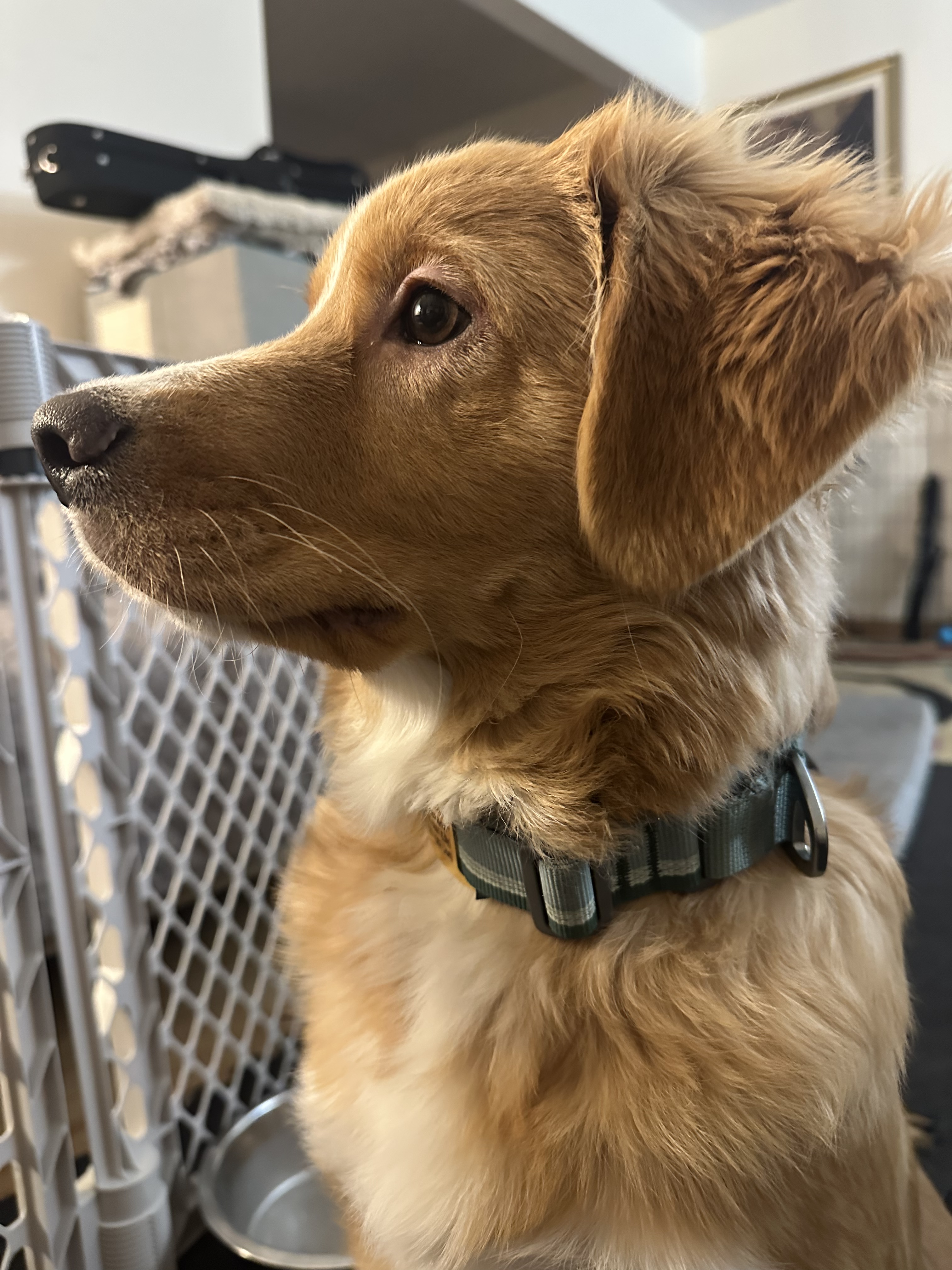
The Emergency Recall is a command everyone should have in their arsenal: a recall that your dog finds more rewarding than ANYTHING ELSE in the world. It’s not your usual “COME” or “HERE” command where you’ll reward sometimes but not every time in the future. It’s a recall you will throw a party for, every time, without fail. Like — your dog hears this word or phrase and they will stop chasing even the most alluring of squirrels because when they get to you, it’s THE BEST THING EVER. EVERY TIME. For Waffles, right now, this is his favorite ball and a huge jackpot of treats he cannot resist. We have a specific word we use for it, and it’s not one we accidentally say around the house. Use a word or phrase like “PARTY!” or “PINEAPPLES!” or “PANTS OFF DANCE OFF!” or a come command in another language — something you’ll easily remember — and practice practice practice. Make sure it ends with a collar grab right before your treat and toy and awesomeness party!

This past week in public training news, Waffles has worked hard on chilling and watching the world go by without needing to greet everyone he sees. He got to hang out in an office building, check out the halls and the stairwells, and the elevators!
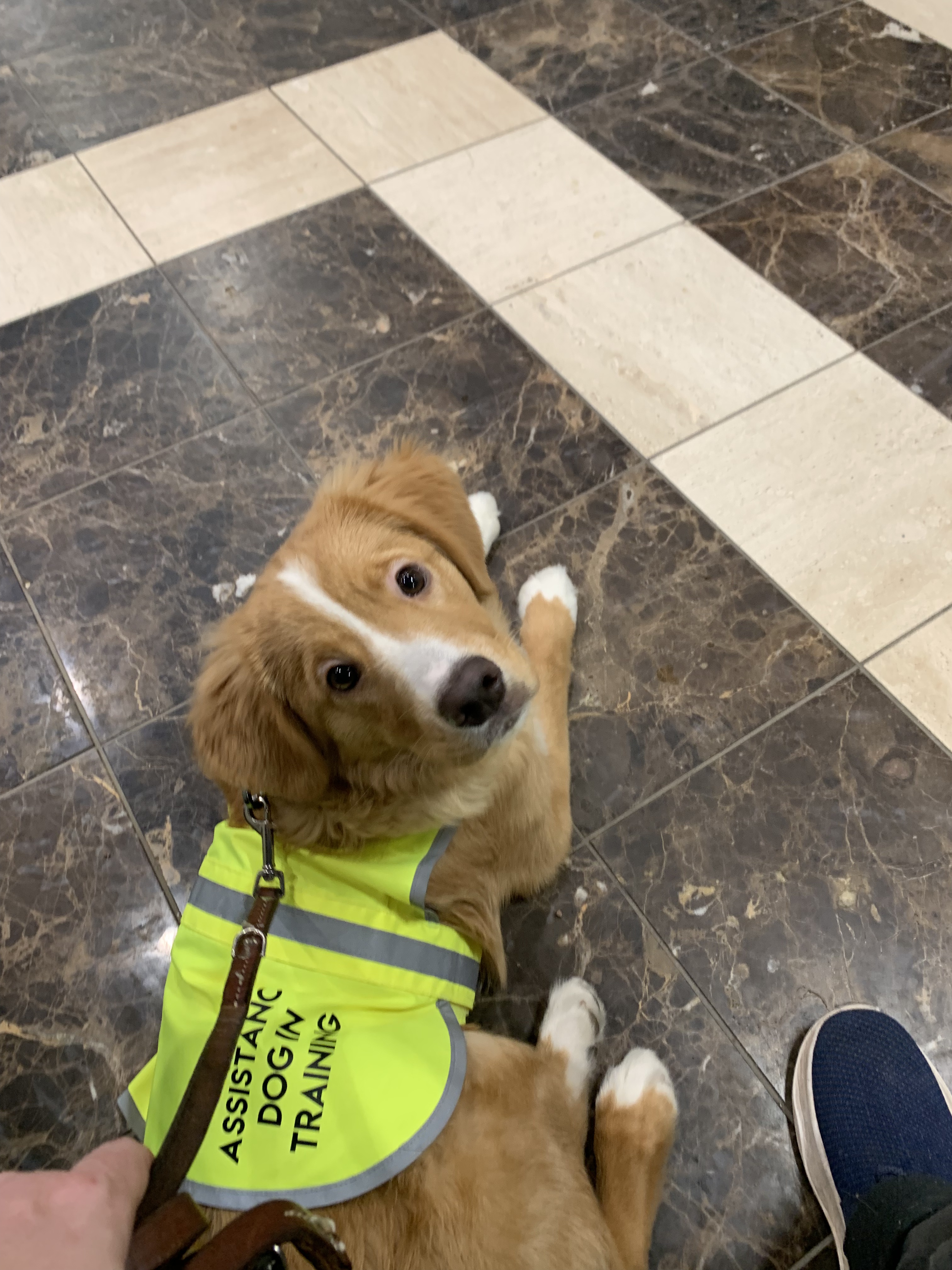
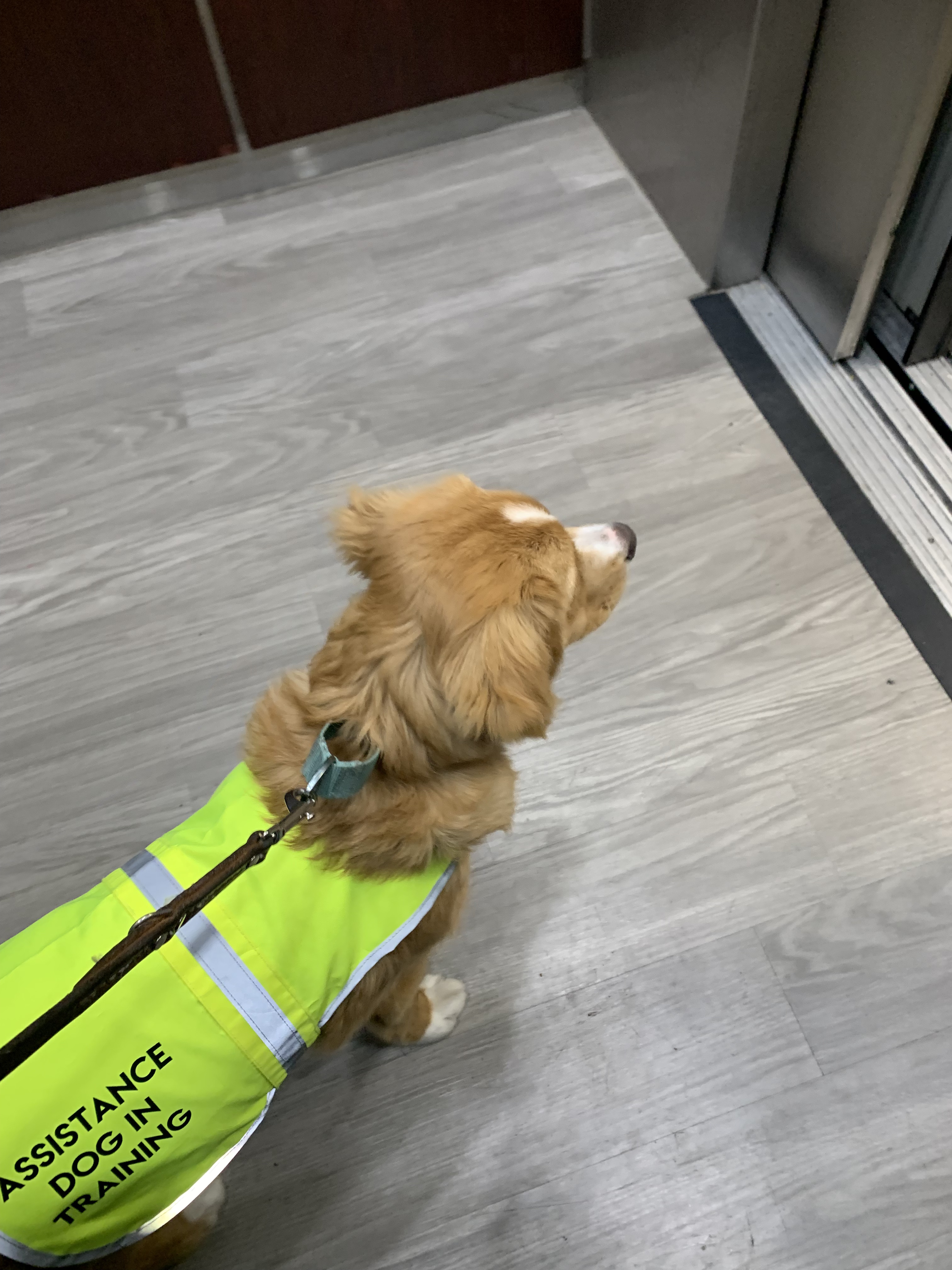
He has also taken his very first elevator rides and thought they were pretty neat.
A few nights ago, he spent some time watching people in our neighborhood play hockey. Thankfully, the noise didn’t bother him at all! He’s a very curious puppy who likes to observe the world around him, while regularly checking in with me as if to ask my opinion about it.

This brings me to a thing a couple of people with young therapy dogs and working dogs in training asked me about: bonding and partnership. Honestly, it’s a complicated topic in the training world, and there are as many opinions about it as there are trainers and training philosophies out there. Here are some of the questions I’ve fielded on the topic in the last month:
Q: I just got my new puppy. Her breeder and our trainer say I’m doing all the training things right. But I just can’t seem to… bond. I see other people fall in love right away, but I don’t feel it yet. And puppies are a hell of a lot of work! Am I a bad pet parent? Are we doomed?
A: You’re not a bad pet parent, and you’re not doomed. You’re also not alone. Relationships aren’t built in a day. Your new puppy is a living, breathing little critter with a personality of its own. You barely know each other yet! Give it time. It’ll come. Don’t fall for the weird expectation people think is the norm: that we fall immediately in love and everything is sunshine and roses. Puppies are demanding little beasts, with wants and needs and opinions (!) and many, many sharp little teeth. They’re learning. You’re learning. The bond will come as you learn together. (A note to new moms of human children: if you don’t immediately feel that “ermergherd I’m deeply in love with this baby” thing you think is supposed to happen immediately after they’ve been evicted from the Not-So-Easy-Bake Oven, don’t fret. It, too, will come as you and bebbeh get to know each other.)

Q: You and the Breakfast of Champions seem to have such a nice bond! How’d you do it? He’s so focussed and loves to do things?! Lucky you!
A: Lucky is the right word! To be honest, when we discussed bringing in a new working prospect into our lives, I was really apprehensive. I am so closely bonded to my retired boy Archer that I was worried I’d have trouble connecting to a new dog in the same way. Truth be told, it took no time at all — what really helped was reminding myself that Waffles is his own wee self, and not to be compared to his predecessors. It sure didn’t hurt that he has an awesome temperament and that he has a high social drive! It also didn’t hurt that I’d gotten to spend a lot of time with his litter as they grew up, and his breeder, Dan, was an absolute trouper who gave me daily updates and fed my puppy fever with a puppy cam feed.
As far as how Waffles and I learned to connect? We spend time together. A lot of time. Our days are structured and have a pretty steady routine where we train, play, train some more, play some more, learn new things, and discuss the history of mathematics and the latest hot topics in astrophysics. I wish I was kidding about that last bit, but in truth, I talk to my dogs. A lot. We putter around the house and I narrate things like I would around a toddler learning about the world around them. Waffles follows me around and explores, and has learned to respond to my tone of voice and levels of excitement (and calm!) my words convey. He picks up new nouns and verbs and I reinforce as we putter along. Because of this, we just enjoy spending time with each other. It also means that when we train, he’s used to paying attention to my words of praise and encouragement, so he’s always keen to show off what he knows when he hears a familiar word/command!
A few years ago, I heard some Australian cattle dog trainers refer to the early months of training a new puppy as one where you establish a “bluetooth connection” with your dog — where you spend enough time with each other doing things and learning that you can communicate with each other with little effort, and without the need for physical handling. You learn to read your dog, your dog learns to read you. It normally takes MONTHS for this to really gel. Sometimes you get lucky and something clicks really early on. It’s a meeting of the minds, of sorts. Something about a puppy’s personality and your own that just means you understand each other faster, and your strengths match each other (rather than some characteristics feeding upon each other like, say, an anxious person with an anxious dog — they’ll understand each other, but feed each other’s anxiety easily. It takes a little longer to establish a working relationship where everyone is confident, but it will come with work and patience!) I think that this is perhaps the second time I’ve had a puppy with whom this “bluetooth connection” has happened within weeks. So cut yourself some slack. Give it time.
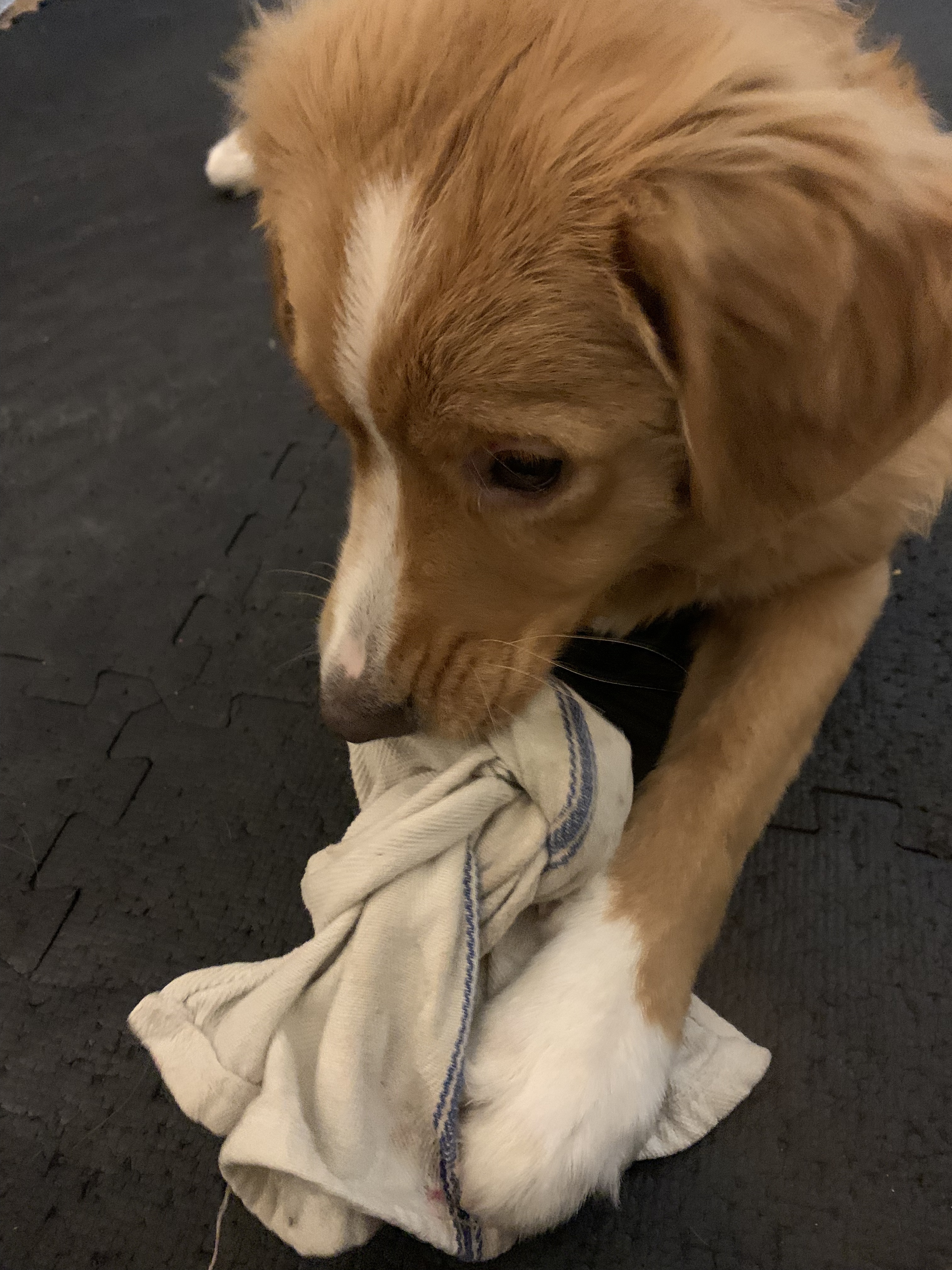
Q: Puppies are so frickin’ demanding. It never stops. I feel like I can’t enjoy my new puppy… she always needs something, she’s destroying the house, and she’s perpetually being naughty. HELP?
A: I wish I had all the answers! Puppies are a heck of a lot of work. But here’s what helps me stay sane during the rough patches of puppyhood and adolescence.
- Schedules. Seriously — a set time of day for walks, for training, for potty breaks, for play, and for “chilling out” and learning to relax.
- Logging everything. I’ve raised a heck of a lot of dogs in my day, but every day, I log when my puppy gets up, and when he goes down for a nap. Why? Because sometimes he turns into an absolute biting maniac and if I look at the log, I quickly realize buddy’s been up for 1.5 hours and really REALLY needs a nap. Speaking of:
- Enforced napping and quiet time. When my puppies have been up for an hour to hour and a half, they’re offered a Kong and some down time in their crates. They pass the heck out within five minutes and snooze for one to two hours, every time. Puppies need way more sleep than we think they do. Adolescents need a little less, but they do need to learn how to chill out and be bored, in a safe space, and quietly chew on a thing and nap.
- Progressive freedom. This is a controversial thing for some people — but I’ve had a lot of success by limiting the amount of space my puppies have access to when they come home. We start out with a pen, otherwise puppy is tethered to me. As they grow and learn house manners, they get more freedom in the house, with supervision. For Waffles, he started out with his crate in a pen. Then he got access to the entire living room, but with temptations fenced off (cords, couches, etc.) At 5 months, he now has access to the kitchen, the hallway, the bathroom, and more space when he’s accompanied (off leash) and because he’s had time to mature, he calmly just joins me and explores without getting into any trouble. He has turned into a calm companion who just enjoys tagging along and checking out what I’m up to rather than a fiend who runs around like a maniac and gets into everything. Another lovely side effect to this approach is that your puppy learns that you walking away into another room doesn’t mean he (a) has to freak out; (b) turn into a destruction machine; and (c) he has plenty he can do to chill until you return. Right now, when I leave Waffles’ space, he picks up a chew or a toy and heads to his mat and chills out. I often speak to him so he can still hear me, but he doesn’t feel the need to follow me everywhere. This is the groundwork that helps shape a confident, non-anxious dog who has faith in your ability to lead.
- Limiting toys and rotating toys. Always have something handy to trade your puppy. We keep a small number of toys in rotation, same with chews, as pups can get bored or overwhelmed by variety.
- Behavior is communication. If your puppy is being an absolute turd, try to figure out what he’s asking you for: Does he want to play? Does he need to chew on something rather than someone? Is he hungry? Bored? Overtired? Behavior is communication. What’s your puppy telling you?
- It’s okay to put puppy away and take a break. Some days are just hard. Give puppy the best Kong ever and put him in his crate for a bit. He may be insulted, but you gave him something to do and he’ll be fine. He needs to learn to self soothe, and you need a break. Go eat a pint of ice cream or watch a favorite show — just don’t turn the puppy into a pair of mittens yet.
- Think “management” instead of “correcting all the time.” By this, I mean there’s nothing wrong with puppy proofing your house. Don’t want puppy to chew on the couch? Don’t give her access to the couch. Don’t want puppy to steal the kids’ toys? Don’t let her have access to them. Don’t want puppy to pounce on guests? Put puppy on a leash and don’t give her the opportunity to pounce. Set your puppy up for success, and remember that she will learn household manners as she matures, if you’re consistent. You can’t teach everything at once, and puppy doesn’t need access to all-the-things and all-the-space all at once! Work on self-regulation, impulse control, and rewarding calm behavior. You’ll be amazed at how those things will stick around when you gradually grant puppy more freedom. She’ll know what to do to channel her energy, she’ll know what behavior you expect from her, and she’ll be less likely to get into trouble.
- Reward the behavior you want to see. Over and over and over and over and over and over again. Reward calm. Reward self-entertainment. Reward your dog for exploring things that startled them. Reward them for checking in with you. Make yourself a person they want to hang out with!
- Keep your sense of humor and be kind to yourself (and your puppy!) Puppyhood and adolescence are short, and strong foundations make for great dogs. Join some classes. Get help and feedback from trainers. Get ahead of problems before they become harder to handle. Ask questions! If something isn’t working, look for other solutions and opinions! Each doggo is different.

Hopefully someone finds some of these bits of insight useful!
On our end, this week we plan to keep working on all our obedience skills, our communication skills, and some of our naughty behaviors that need some redirection. We have a few classes on the schedule along with some public training time. It should be fun!
Have a great week, everyone! Let me know if there’s a particular topic you’d like me to tackle next!
 Keep Calm & Waffle On
Leave a comment